
News
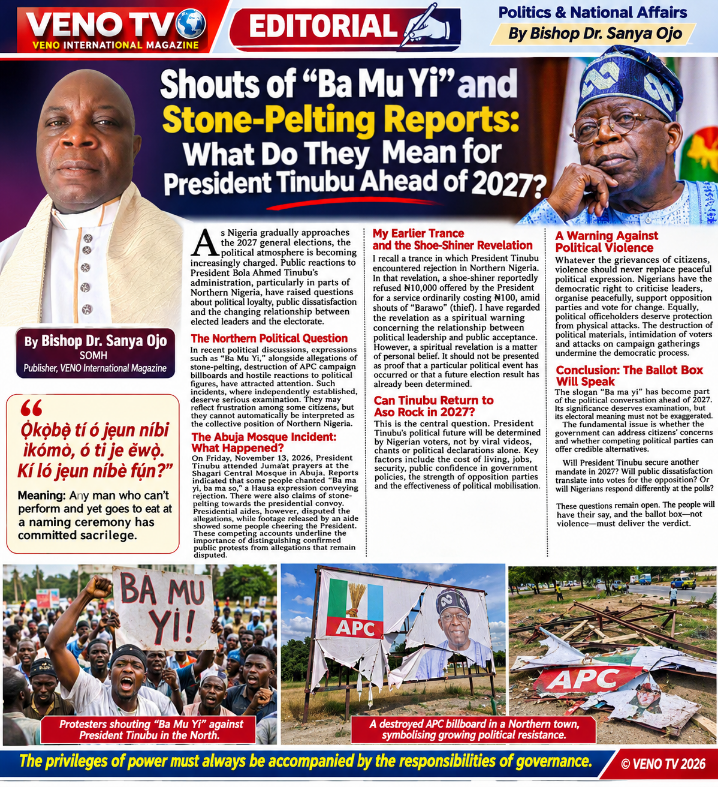
VENO TV | EDITORIAL | POLITICS SHOUTS OF “BA MU YI” AND STONE-PELTING REPORTS: WHAT DO THEY MEAN FOR PRESIDENT TINUBU AHEAD OF 2027? Are the reported protests isolated expressions of anger, or signs of a wider political challenge in Northern Nigeria? By Bishop Dr. Sanya Ojo
Date: 14-11-26
As Nigeria gradually approaches the 2027 general elections, the political atmosphere is becoming increasingly charged. Public reactions to President Bola Ahmed Tinubu's administration, particularly in parts of Northern Nigeria, have raised questions about political loyalty, public dissatisfaction and the changing relationship between elected leaders and the electorate.
In Yoruba, there is a thought-provoking proverb:
“??k??b?? tí ó j?un níbi ìk??m?, ó ti j? ??w??. Kí ló j?un níb?? fún?”
The proverb, as used in this editorial, describes a person who participates in a celebration despite being unable to fulfil the responsibility expected of him.
In political terms, it raises a fundamental question: Should public officeholders continue to enjoy the privileges of leadership when citizens believe their expectations have not been met?
Democracy, however, requires that such questions be answered through evidence, public accountability and the ballot box.
The Northern Political Question
In recent political discussions, expressions such as “Ba Mu Yi,” alongside allegations of stone-pelting, destruction of APC campaign billboards and hostile reactions to political figures, have attracted attention.
Such incidents, where independently established, deserve serious examination. They may reflect frustration among some citizens, but they cannot automatically be interpreted as the collective position of Northern Nigeria.
The North is politically diverse, with different communities, parties, interests and electoral priorities.
Nevertheless, the underlying question remains important: What is driving the dissatisfaction being expressed, and how are political leaders responding?
The Abuja Mosque Incident: What Happened?
On Friday, November 13, 2026, President Tinubu attended Juma'at prayers at the Shagari Central Mosque in Abuja.
Reports indicated that some people chanted “Ba ma yi, ba ma so,” a Hausa expression conveying rejection.
The incident generated conflicting accounts. The ICIR and Peoples Gazette reported that stones were thrown towards the presidential convoy. However, presidential aides disputed the allegations, while footage released by an aide showed some people cheering the President.
These competing accounts underline the importance of distinguishing confirmed public protests from allegations that remain disputed.
My Earlier Trance and the Shoe-Shiner Revelation
I recall a trance in which President Tinubu encountered rejection in Northern Nigeria.
In that revelation, a shoe-shiner reportedly refused ?10,000 offered by the President for a service ordinarily costing ?100. There were also cries of “Barawo,” a Hausa word meaning thief.
I have regarded the revelation as a spiritual warning concerning the relationship between political leadership and public acceptance.
However, a spiritual revelation is a matter of personal belief. It should not be presented as proof that a particular political event has occurred or that a future election result has already been determined.
The reported protests have brought the subject back to my attention.
Can Tinubu Return to Aso Rock in 2027?
This is the central question.
President Tinubu's political future will be determined by Nigerian voters, not by viral videos, chants or political declarations alone.
Several factors deserve attention: the cost of living, employment opportunities, security, public confidence in government policies, the strength of opposition parties and the effectiveness of political mobilisation.
The President and his supporters can point to government reforms and their intended long-term benefits. Critics, meanwhile, question whether those policies have sufficiently improved the everyday lives of Nigerians.
These competing arguments will form part of the democratic debate ahead of 2027.
It is also important to recognise that some reports have described public expressions of support for Tinubu in the North. Therefore, political sentiment across the region should not be reduced to one slogan or one incident.
A Warning Against Political Violence
Whatever the grievances of citizens, violence should never replace peaceful political expression.
Nigerians have the democratic right to criticise leaders, organise peacefully, support opposition parties and vote for change.
Equally, political officeholders and their supporters deserve protection from physical attacks.
The destruction of political materials, intimidation of voters and attacks on campaign gatherings undermine the democratic process.
Conclusion: The Ballot Box Will Speak
The slogan “Ba ma yi” has become part of the political conversation ahead of 2027. Its significance deserves examination, but its electoral meaning must not be exaggerated.
The fundamental issue is whether the government can address citizens' concerns and whether competing political parties can offer credible alternatives.
As a clergyman, publisher and observer of political developments, I believe leadership carries a sacred responsibility to serve the people.
The privileges of power must always be accompanied by the responsibilities of governance.
Will President Tinubu secure another mandate in 2027? Will public dissatisfaction translate into votes for the opposition? Or will Nigerians respond differently when they enter the polling booths?
These questions remain open.
The people will have their say, and the ballot box—not violence—must deliver the verdict.
Bishop Dr. Sanya Ojo SOMH
Publisher, VENO International Magazine
© VENO TV 2026
+2348033340285
Date: 14-11-26
As Nigeria gradually approaches the 2027 general elections, the political atmosphere is becoming increasingly charged. Public reactions to President Bola Ahmed Tinubu's administration, particularly in parts of Northern Nigeria, have raised questions about political loyalty, public dissatisfaction and the changing relationship between elected leaders and the electorate.
In Yoruba, there is a thought-provoking proverb:
“??k??b?? tí ó j?un níbi ìk??m?, ó ti j? ??w??. Kí ló j?un níb?? fún?”
The proverb, as used in this editorial, describes a person who participates in a celebration despite being unable to fulfil the responsibility expected of him.
In political terms, it raises a fundamental question: Should public officeholders continue to enjoy the privileges of leadership when citizens believe their expectations have not been met?
Democracy, however, requires that such questions be answered through evidence, public accountability and the ballot box.
The Northern Political Question
In recent political discussions, expressions such as “Ba Mu Yi,” alongside allegations of stone-pelting, destruction of APC campaign billboards and hostile reactions to political figures, have attracted attention.
Such incidents, where independently established, deserve serious examination. They may reflect frustration among some citizens, but they cannot automatically be interpreted as the collective position of Northern Nigeria.
The North is politically diverse, with different communities, parties, interests and electoral priorities.
Nevertheless, the underlying question remains important: What is driving the dissatisfaction being expressed, and how are political leaders responding?
The Abuja Mosque Incident: What Happened?
On Friday, November 13, 2026, President Tinubu attended Juma'at prayers at the Shagari Central Mosque in Abuja.
Reports indicated that some people chanted “Ba ma yi, ba ma so,” a Hausa expression conveying rejection.
The incident generated conflicting accounts. The ICIR and Peoples Gazette reported that stones were thrown towards the presidential convoy. However, presidential aides disputed the allegations, while footage released by an aide showed some people cheering the President.
These competing accounts underline the importance of distinguishing confirmed public protests from allegations that remain disputed.
My Earlier Trance and the Shoe-Shiner Revelation
I recall a trance in which President Tinubu encountered rejection in Northern Nigeria.
In that revelation, a shoe-shiner reportedly refused ?10,000 offered by the President for a service ordinarily costing ?100. There were also cries of “Barawo,” a Hausa word meaning thief.
I have regarded the revelation as a spiritual warning concerning the relationship between political leadership and public acceptance.
However, a spiritual revelation is a matter of personal belief. It should not be presented as proof that a particular political event has occurred or that a future election result has already been determined.
The reported protests have brought the subject back to my attention.
Can Tinubu Return to Aso Rock in 2027?
This is the central question.
President Tinubu's political future will be determined by Nigerian voters, not by viral videos, chants or political declarations alone.
Several factors deserve attention: the cost of living, employment opportunities, security, public confidence in government policies, the strength of opposition parties and the effectiveness of political mobilisation.
The President and his supporters can point to government reforms and their intended long-term benefits. Critics, meanwhile, question whether those policies have sufficiently improved the everyday lives of Nigerians.
These competing arguments will form part of the democratic debate ahead of 2027.
It is also important to recognise that some reports have described public expressions of support for Tinubu in the North. Therefore, political sentiment across the region should not be reduced to one slogan or one incident.
A Warning Against Political Violence
Whatever the grievances of citizens, violence should never replace peaceful political expression.
Nigerians have the democratic right to criticise leaders, organise peacefully, support opposition parties and vote for change.
Equally, political officeholders and their supporters deserve protection from physical attacks.
The destruction of political materials, intimidation of voters and attacks on campaign gatherings undermine the democratic process.
Conclusion: The Ballot Box Will Speak
The slogan “Ba ma yi” has become part of the political conversation ahead of 2027. Its significance deserves examination, but its electoral meaning must not be exaggerated.
The fundamental issue is whether the government can address citizens' concerns and whether competing political parties can offer credible alternatives.
As a clergyman, publisher and observer of political developments, I believe leadership carries a sacred responsibility to serve the people.
The privileges of power must always be accompanied by the responsibilities of governance.
Will President Tinubu secure another mandate in 2027? Will public dissatisfaction translate into votes for the opposition? Or will Nigerians respond differently when they enter the polling booths?
These questions remain open.
The people will have their say, and the ballot box—not violence—must deliver the verdict.
Bishop Dr. Sanya Ojo SOMH
Publisher, VENO International Magazine
© VENO TV 2026
+2348033340285
LINKS
- VENO TV | EDITORIAL | POLITICS SHOUTS OF “BA MU YI” AND STONE-PELTING REPORTS: WHAT DO THEY MEAN FOR PRESIDENT TINUBU AHEAD OF 2027? Are the reported protests isolated expressions of anger, or signs of a wider political challenge in Northern Nigeria? By Bishop Dr. Sanya Ojo- VENO TV: HOSPITALITY & TOURISM GRACEVILLA CASTLE HOTEL: A PLACE TO BE! Experience Royalty, Feel at Home Hotel Manager, Olajumoke Olatinwo, Speaks on Hospitality, Electricity Challenges, January Official Opening and Future Expansion Plans
- VENO TV | FEATURE MEET NELLY AGWU: A DYNAMIC EDUCATIONIST, JOURNALIST, BLOGGER, AND VOICE OF THE OPPRESSED A Woman of Substance, Courage, Compassion and Intellectual Excellence
- VENO tv: Business Access Holdings Chairman calls for productive finance, stronger African banks, and deeper continental integration at AFIS 2026
- VENO tv: Politics 2027 ELECTION: “THE PANIC IS REAL” — ATIKU Who Is Afraid of Atiku?
- VENO tv: Business Access Bank Plc Appoints Oluseyi Kumapayi as DMD, African Subsidiaries
- VENO TV | FEATURE | ROYAL NEWS Prince Mayowa Aroloye Emerges New Owa-Elect of Idanre Defeats six other contenders as Idanreland prepares to welcome a new traditional ruler after over two years without a substantive monarch.
- EDITORIAL | NOVEMBER 3, 2026 TINUBU KISSES BLACK STONE IN MAKKAH: HISTORY, FAITH AND THE DEBATE OVER NIGERIAN PRESIDENTS Abacha, Buhari and Tinubu: Is History Repeating Itself, or Are Nigerians Reading Too Much Into a Religious Tradition?
- VENO TV | FOREIGN NEWS | NOVEMBER 2, 2026 British Man Completes Round-the-World Walk After 28 Years Former British soldier Karl Bushby covers approximately 50,000 kilometres across four continents, returns home to emotional welcome.
- VENO TV | FOREIGN NEWS King Charles Acknowledges Injustices of Slavery, as Caribbean Nations Demand Reparations British monarch admits historical suffering during Caribbean visit but stops short of formal apology.
- VENO TV: FirstBank Partners Google Pay, Expands Digital Payment Options for Cardholders Bank strengthens digital banking innovation with secure, convenient and contactless payment solutions.
- VENO tv: ISRAEL ELECTION: GADI EISENKOT EMERGES AS NETANYAHU'S MAIN CHALLENGER AS POLLS NEAR CLOSE Former Israeli military chief mounts strong opposition challenge as millions vote in crucial parliamentary election.
- VENO TV | FEATURE AMANYANABO DOKUBO-ASARI MEETS GOV. BAGO, INVITES HIM TO SE DIYE IN BUGUMA
- VENO tv: BUSINESS ACCESS HOLDINGS TRANSFORMS WASTE TYRES INTO SCHOOL SANDALS FOR 10,450 CHILDREN
- VENO TV | FEATURE AMANYANABO DOKUBO-ASARI TAKES ROYAL DIPLOMACY TO IFE, SEEKS HISTORIC CULTURAL AND ECONOMIC ALLIANCE WITH OONI From the Source of Elem Kalabari to the cradle of Yoruba civilisation, the royal visit strengthens inter-kingdom friendship ahead of the December 19 SE DIYE coronation ceremony.
- VENO tv | ENTERTAINMENT NEWS Friday, October 23, 2026 RAYE WINS 2026 MERCURY PRIZE FOR SECOND ALBUM British singer defeats Paul McCartney, Olivia Dean and other top stars to claim prestigious music award.
- VENO tv | FEATURE MY TRIBUTE TO MY DEPARTED HUSBAND: A GALLANT SOLDIER IS GONE A Life of Service, Love, Sacrifice and Enduring Legacy By Morohunmubo Anike Okosun (Mubo Okosun)
- VENO TV OPINION 2027 ELECTION: AJÁ TÓ BÁ GBÉ EGUNGUN S??NU, KÒ LÈ GBÓ! “A DOG WITH A BONE IN ITS MOUTH CANNOT BARK!” When the voices of conscience become silent, who will speak for the suffering masses?
- VENO tv: DA-AMAKIRI TUBO: THE JOURNEY OF AMANYANABO MUJAHID ABUBAKR DOKUBO-ASARI From the Niger Delta struggle to the throne of Elem Kalabari: A life shaped by conviction, sacrifice and service
- VENO tv | FROM THE PULPIT SUNDAY TONIC WITH PASTOR PRINCESS VENISA OJO Popularly known as Omo Oba Jesu FAITH TRIUMPHS IN TROUBLE
Page 1 of 71 [Next] [Last Page]