
News
EDITORIAL | NOVEMBER 3, 2026 TINUBU KISSES BLACK STONE IN MAKKAH: HISTORY, FAITH AND THE DEBATE OVER NIGERIAN PRESIDENTS Abacha, Buhari and Tinubu: Is History Repeating Itself, or Are Nigerians Reading Too Much Into a Religious Tradition?
Date: 03-11-26
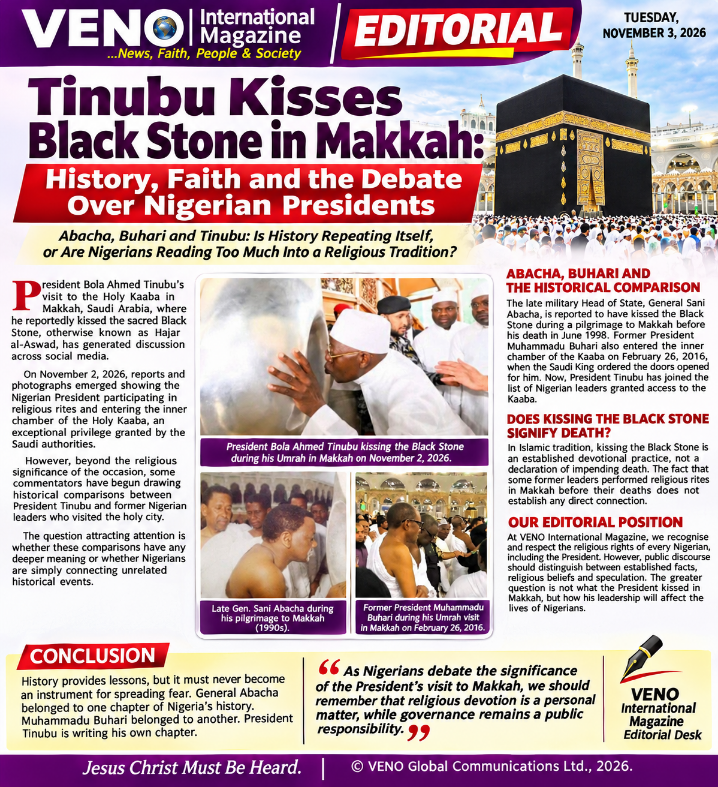
President Bola Ahmed Tinubu's visit to the Holy Kaaba in Makkah, Saudi Arabia, where he reportedly kissed the sacred Black Stone, otherwise known as Hajar al-Aswad, has generated discussion across social media.
On November 2, 2026, reports and photographs emerged showing the Nigerian President participating in religious rites and entering the inner chamber of the Holy Kaaba, an exceptional privilege granted by the Saudi authorities.
However, beyond the religious significance of the occasion, some commentators have begun drawing historical comparisons between President Tinubu and former Nigerian leaders who visited the holy city.
The question attracting attention is whether these comparisons have any deeper meaning or whether Nigerians are simply connecting unrelated historical events.
ABACHA, BUHARI AND THE HISTORICAL COMPARISON
The late military Head of State, General Sani Abacha, ruled Nigeria from November 1993 until his death on June 8, 1998.
Claims have circulated that Abacha kissed the Black Stone during a pilgrimage to Makkah before his death. However, the precise date and circumstances of that alleged act require independent historical verification.
Former President Muhammadu Buhari also enjoyed the privilege of entering the Holy Kaaba on February 26, 2016, during an official visit to Saudi Arabia.
The doors of the sacred structure were opened to Buhari and members of his delegation on the instruction of King Salman bin Abdulaziz Al Saud.
Buhari subsequently completed his presidency in May 2023 and died in July 2025.
Now, President Tinubu has joined the list of Nigerian leaders granted access to the interior of the Kaaba.
But there is an important distinction: visiting Makkah, kissing the Black Stone and entering the Kaaba are not identical religious acts. Historical comparisons must therefore be made carefully.
DOES KISSING THE BLACK STONE HAVE ANY CONNECTION WITH DEATH?
This is perhaps the most sensitive question arising from the public discussion.
In Islamic tradition, kissing the Black Stone is an established devotional practice associated with the example of Prophet Muhammad (peace be upon him).
It is neither a declaration of impending death nor a religious prediction concerning the future of an individual.
Every human being, whether president, king, governor, religious leader or ordinary citizen, will eventually face death.
Therefore, the fact that some former leaders performed religious rites in Makkah before their deaths does not establish a relationship between those rites and their eventual passing.
Coincidence should not automatically become prophecy, and historical events should not be interpreted without sufficient evidence.
TINUBU'S PRAYERS AND NIGERIA'S EXPECTATIONS
According to the Presidency, President Tinubu used the spiritual opportunity to pray for Nigeria's peace, unity, prosperity and development.
He also expressed appreciation to the Saudi leadership for granting him and his delegation access to the sacred chamber.
For millions of Nigerians confronting economic difficulties, insecurity and other national challenges, the President's prayers may offer an occasion for reflection.
Nevertheless, prayer and public responsibility should complement one another.
Nigerians are entitled to expect practical governance, improved security, economic opportunities, stronger institutions and policies that improve everyday living conditions.
OUR EDITORIAL POSITION
At VENO International Magazine, we recognise and respect the religious rights of every Nigerian, including the President of the Federal Republic.
President Tinubu has the constitutional freedom to practise his religion, just as other citizens have the right to observe their respective faiths.
However, public discourse should distinguish between established facts, religious beliefs and unverified speculation.
The circumstances surrounding Abacha's death, Buhari's later passing and Tinubu's present pilgrimage should not be presented as evidence of a supernatural pattern.
We also believe that the President's religious devotion should not prevent legitimate public scrutiny of his administration.
The greater question is not what the President kissed in Makkah, but how his leadership will affect the lives of Nigerians.
Will the prayers for peace translate into improved security?
Will the desire for prosperity be reflected in greater economic opportunities?
Will the commitment to national unity strengthen peaceful coexistence among Nigerians?
These are legitimate questions that deserve attention.
CONCLUSION: LET HISTORY TEACH, NOT FRIGHTEN US
History provides lessons, but it must never become an instrument for spreading fear or unfounded predictions.
General Sani Abacha belonged to one chapter of Nigeria's history. Muhammadu Buhari belonged to another. President Bola Ahmed Tinubu is writing his own chapter.
Their religious experiences may invite comparison, but their political circumstances and personal destinies cannot simply be equated.
As Nigerians debate the significance of the President's visit to Makkah, we should remember that religious devotion is a personal matter, while governance remains a public responsibility.
May Almighty God grant Nigeria peace, wisdom, unity and prosperity.
Date: 03-11-26
President Bola Ahmed Tinubu's visit to the Holy Kaaba in Makkah, Saudi Arabia, where he reportedly kissed the sacred Black Stone, otherwise known as Hajar al-Aswad, has generated discussion across social media.
On November 2, 2026, reports and photographs emerged showing the Nigerian President participating in religious rites and entering the inner chamber of the Holy Kaaba, an exceptional privilege granted by the Saudi authorities.
However, beyond the religious significance of the occasion, some commentators have begun drawing historical comparisons between President Tinubu and former Nigerian leaders who visited the holy city.
The question attracting attention is whether these comparisons have any deeper meaning or whether Nigerians are simply connecting unrelated historical events.
ABACHA, BUHARI AND THE HISTORICAL COMPARISON
The late military Head of State, General Sani Abacha, ruled Nigeria from November 1993 until his death on June 8, 1998.
Claims have circulated that Abacha kissed the Black Stone during a pilgrimage to Makkah before his death. However, the precise date and circumstances of that alleged act require independent historical verification.
Former President Muhammadu Buhari also enjoyed the privilege of entering the Holy Kaaba on February 26, 2016, during an official visit to Saudi Arabia.
The doors of the sacred structure were opened to Buhari and members of his delegation on the instruction of King Salman bin Abdulaziz Al Saud.
Buhari subsequently completed his presidency in May 2023 and died in July 2025.
Now, President Tinubu has joined the list of Nigerian leaders granted access to the interior of the Kaaba.
But there is an important distinction: visiting Makkah, kissing the Black Stone and entering the Kaaba are not identical religious acts. Historical comparisons must therefore be made carefully.
DOES KISSING THE BLACK STONE HAVE ANY CONNECTION WITH DEATH?
This is perhaps the most sensitive question arising from the public discussion.
In Islamic tradition, kissing the Black Stone is an established devotional practice associated with the example of Prophet Muhammad (peace be upon him).
It is neither a declaration of impending death nor a religious prediction concerning the future of an individual.
Every human being, whether president, king, governor, religious leader or ordinary citizen, will eventually face death.
Therefore, the fact that some former leaders performed religious rites in Makkah before their deaths does not establish a relationship between those rites and their eventual passing.
Coincidence should not automatically become prophecy, and historical events should not be interpreted without sufficient evidence.
TINUBU'S PRAYERS AND NIGERIA'S EXPECTATIONS
According to the Presidency, President Tinubu used the spiritual opportunity to pray for Nigeria's peace, unity, prosperity and development.
He also expressed appreciation to the Saudi leadership for granting him and his delegation access to the sacred chamber.
For millions of Nigerians confronting economic difficulties, insecurity and other national challenges, the President's prayers may offer an occasion for reflection.
Nevertheless, prayer and public responsibility should complement one another.
Nigerians are entitled to expect practical governance, improved security, economic opportunities, stronger institutions and policies that improve everyday living conditions.
OUR EDITORIAL POSITION
At VENO International Magazine, we recognise and respect the religious rights of every Nigerian, including the President of the Federal Republic.
President Tinubu has the constitutional freedom to practise his religion, just as other citizens have the right to observe their respective faiths.
However, public discourse should distinguish between established facts, religious beliefs and unverified speculation.
The circumstances surrounding Abacha's death, Buhari's later passing and Tinubu's present pilgrimage should not be presented as evidence of a supernatural pattern.
We also believe that the President's religious devotion should not prevent legitimate public scrutiny of his administration.
The greater question is not what the President kissed in Makkah, but how his leadership will affect the lives of Nigerians.
Will the prayers for peace translate into improved security?
Will the desire for prosperity be reflected in greater economic opportunities?
Will the commitment to national unity strengthen peaceful coexistence among Nigerians?
These are legitimate questions that deserve attention.
CONCLUSION: LET HISTORY TEACH, NOT FRIGHTEN US
History provides lessons, but it must never become an instrument for spreading fear or unfounded predictions.
General Sani Abacha belonged to one chapter of Nigeria's history. Muhammadu Buhari belonged to another. President Bola Ahmed Tinubu is writing his own chapter.
Their religious experiences may invite comparison, but their political circumstances and personal destinies cannot simply be equated.
As Nigerians debate the significance of the President's visit to Makkah, we should remember that religious devotion is a personal matter, while governance remains a public responsibility.
May Almighty God grant Nigeria peace, wisdom, unity and prosperity.
LINKS
- EDITORIAL | NOVEMBER 3, 2026 TINUBU KISSES BLACK STONE IN MAKKAH: HISTORY, FAITH AND THE DEBATE OVER NIGERIAN PRESIDENTS Abacha, Buhari and Tinubu: Is History Repeating Itself, or Are Nigerians Reading Too Much Into a Religious Tradition?- VENO TV | FOREIGN NEWS | NOVEMBER 2, 2026 British Man Completes Round-the-World Walk After 28 Years Former British soldier Karl Bushby covers approximately 50,000 kilometres across four continents, returns home to emotional welcome.
- VENO TV | FOREIGN NEWS King Charles Acknowledges Injustices of Slavery, as Caribbean Nations Demand Reparations British monarch admits historical suffering during Caribbean visit but stops short of formal apology.
- VENO TV: FirstBank Partners Google Pay, Expands Digital Payment Options for Cardholders Bank strengthens digital banking innovation with secure, convenient and contactless payment solutions.
- VENO tv: ISRAEL ELECTION: GADI EISENKOT EMERGES AS NETANYAHU'S MAIN CHALLENGER AS POLLS NEAR CLOSE Former Israeli military chief mounts strong opposition challenge as millions vote in crucial parliamentary election.
- VENO TV | FEATURE AMANYANABO DOKUBO-ASARI MEETS GOV. BAGO, INVITES HIM TO SE DIYE IN BUGUMA
- VENO tv: BUSINESS ACCESS HOLDINGS TRANSFORMS WASTE TYRES INTO SCHOOL SANDALS FOR 10,450 CHILDREN
- VENO TV | FEATURE AMANYANABO DOKUBO-ASARI TAKES ROYAL DIPLOMACY TO IFE, SEEKS HISTORIC CULTURAL AND ECONOMIC ALLIANCE WITH OONI From the Source of Elem Kalabari to the cradle of Yoruba civilisation, the royal visit strengthens inter-kingdom friendship ahead of the December 19 SE DIYE coronation ceremony.
- VENO tv | ENTERTAINMENT NEWS Friday, October 23, 2026 RAYE WINS 2026 MERCURY PRIZE FOR SECOND ALBUM British singer defeats Paul McCartney, Olivia Dean and other top stars to claim prestigious music award.
- VENO tv | FEATURE MY TRIBUTE TO MY DEPARTED HUSBAND: A GALLANT SOLDIER IS GONE A Life of Service, Love, Sacrifice and Enduring Legacy By Morohunmubo Anike Okosun (Mubo Okosun)
- VENO TV OPINION 2027 ELECTION: AJÁ TÓ BÁ GBÉ EGUNGUN S??NU, KÒ LÈ GBÓ! “A DOG WITH A BONE IN ITS MOUTH CANNOT BARK!” When the voices of conscience become silent, who will speak for the suffering masses?
- VENO tv: DA-AMAKIRI TUBO: THE JOURNEY OF AMANYANABO MUJAHID ABUBAKR DOKUBO-ASARI From the Niger Delta struggle to the throne of Elem Kalabari: A life shaped by conviction, sacrifice and service
- VENO tv | FROM THE PULPIT SUNDAY TONIC WITH PASTOR PRINCESS VENISA OJO Popularly known as Omo Oba Jesu FAITH TRIUMPHS IN TROUBLE
- VENO tv: BUSINESS FirstBank Sponsors 2026 Georgian Cup, Reaffirms Commitment to Polo Historic partnership dating back to 1919 celebrates over a century of sporting excellence.
- VENO tv | FEATURE BEFORE SCOOPING FUEL FROM A FALLEN TANKER, WRITE YOUR WILL
- VENO TV: POLITICS GOVERNOR ADELEKE TO PRESIDENT TINUBU: “THE VICTORY HAS COME, THERE IS LIGHT AT THE END OF THE TUNNEL” …As Accord Party Chieftain Distances Party Members from Governor's Declaration
- VENO INTERNATIONAL MAGAZINE EDITORIAL | POLITICS 14 OCTOBER 2026 TINUBU MUST GO VS TINUBU MUST STAY! Two Conflicting Voices, One Nigeria: What Does This Mean for 2027?
- VENO tv | EDITORIAL ON THE MARCH AGAIN! GRAB YOUR PVC AHEAD OF 2027 ELECTIONS Your Permanent Voter's Card Is Your Licence to Participate in Nigeria's Democratic Process
- VENO tv | FOREIGN NEWS UKRAINE NEEDS A NEW PRESIDENT — TRUMP US President Accuses Zelenskyy of Failing to Secure Peace Deal With Russia
- VENO tv: Business FirstBank Hosts and Sponsors the West Africa International Banking Dialogue & Awards Gala 2026.
Page 1 of 71 [Next] [Last Page]